02 Jul When a Child’s Accident Changes the Way You See Everything
When her five-year-old daughter falls from a rocky ledge and escapes with only minor injuries, Kerri Sackville is left shaken by how close her family came to tragedy — and by the uneasy question of why some children are lucky and others are not.
A sunny morning turns frightening
It was a still, sunny Sunday morning. My kids were playing in our backyard, my husband was chatting to his father at the table nearby, and I was watching from the kitchen as I made coffee.
We live on a steep cliff. Our back garden is a courtyard chiselled into the rock face, with a narrow set of steps carved into the stone leading up to a ledge above. When our kids were babies, we joked about losing them on the rocks when they were older. Only recently, however, had they started climbing and exploring.
I looked out the French doors and saw my five-year-old daughter perched high, balancing on a narrow concrete step about two metres up. I called out to my husband and his father to get her down.
“Ah, let her be,” my father-in-law waved me off. “You can’t wrap kids in cotton wool.”
I felt my chest constrict, but decided to concede. He was right, I told myself. I was being overly cautious. I’m known for being anxious; I need to let go for the sake of the kids. Besides, I had often imagined them falling from the rocks, and if you imagine something bad, it never actually happens. Right?
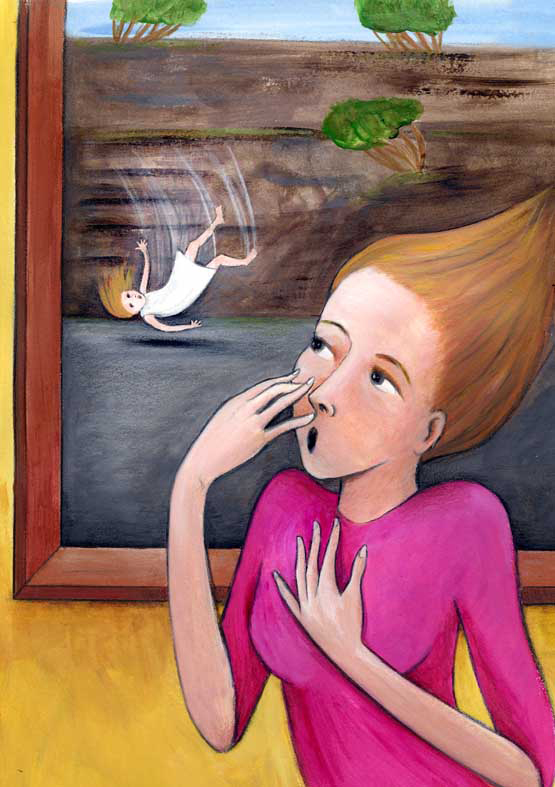
And then she fell.
 The moment every parent fears
There was a cry and a thud as my little girl fell from the step and smacked into the hard pavers. I saw her lying on the ground and screamed. I was running before I was conscious of moving, fighting the urge to hesitate, terrified of what I might find.
She was alive, and she was howling in pain and shock. I scooped her up, uncertain whether I should move her, but desperate to hold her. My husband, father-in-law and I examined her together. Miraculously, she was only slightly injured. She was covered in scrapes and bruises, and had sprained her ankle, but otherwise she was fine.
Over the next few days, as my daughter recovered from her bruises, and we all recovered from the shock, I was haunted. We had come so close to tragedy; we had brushed it with our fingertips. I walked around in a daze, feeling as if my life had forked into two alternate realities. In one — the one I was occupying so tentatively — my daughter had survived the fall with only minor injuries. In the other, which seemed somehow more plausible, she had died, or been horribly maimed.
After the shock
No doubt we were experiencing some kind of post-traumatic stress. Over the following week, my daughter told everyone she met — the medical receptionist, her teachers, the supermarket cashier — that she had “falled off a cliff”. At home, she drew dozens of pictures of her fall, all depicting the steps, with one stick figure perched merrily on top and another lying crumpled on the ground.
My father-in-law rang several times, feeling horribly responsible, though I assured him he wasn’t. His is a valid philosophy, and of course I could have put my foot down. Even my seven-year-old son was disturbed.
“I can’t stop thinking about what happened, Mum,” he told me. “What if she has brain damage?”
She didn’t have brain damage, and eventually we all accepted that we truly had been spared. Though I was indescribably grateful, a pervasive unease remained. Why had my daughter escaped virtually unscathed when so many other children are killed in similar accidents? Why had I been so lucky?
The uneasy question of luck
It was strange, but I felt that same “Why me?” sense of inequity experienced by many whose lives have been blighted by tragedy. My question, though, was in reverse. Why not me? Why had I got off so lightly? Was it God? Or just a random twist of fate?
I recalled the words of a friend who had once discussed her faith in God. “My life is evidence that God exists,” she had said, with absolute conviction. Her reasoning was that she had been blessed with so much good fortune — a loving husband, two beautiful children, affluence, success — there simply had to be a great, benevolent presence shining down on her.
At the time, I thought my friend’s proclamation was ludicrous. Since my daughter’s near miss, I think it’s even more so. My child’s survival — my great good fortune — doesn’t prove there is a God. Because for every child like mine, who narrowly escapes death or serious injury, there is another who doesn’t. For every child who gets lucky, there is a child — equally precious, equally cherished — who drowns in someone’s swimming pool, or is hit by a car, or gets cancer and dies.
Where is God in their lives? Where is God in their parents’ lives? If bad things happen to good people, then surely good things happening to good people isn’t evidence of God.
Gratitude after a near miss
There may not be atheists in foxholes, but I discovered there are indeed atheists in courtyards. When my daughter fell, I didn’t pray to God to save her. I simply hoped with all my heart that she would be okay. When she survived, I didn’t thank God. I just felt grateful for my incredible stroke of luck.
My daughter’s fall could have been a life-changing event. Ultimately, it turned out to be a perception-altering one. For days afterwards, I felt thankful for every precious second with my children, blessing them silently with every interaction.
That kind of intensity, though, like the flush of new romance, is impossible to sustain. A few days after the accident, I got irritated with my son; a day or two later, I lost my temper with my daughter. Now, a couple of months down the track, I have returned to my usual love for my kids, which ebbs and flows with my moods and their behaviour.
Through it all, though, I have managed to retain that ongoing sense of gratitude. And I am keenly, painfully aware of those who haven’t been as lucky as me. In an instant, I could have been one of them.