
15 Dec Why Studying in France Gave Our Children More Than Just Language Skills
As her girls say au revoir to their French school, Claire Williams reflects on everything they learned.
Discovering Food, Language and Everyday French Life
“So how’s your rosé?” asked my seven year old earnestly as she licked the brie off her baguette. Before this trip she knew there were two types of wine – red and white. Now, after a school excursion to a vineyard, she was beginning to consider herself something of a connoisseur.
While she had focused on the wine, her nine-year-old sister had become an expert on goat’s cheese. “Je voudrais le nature, s’il vous plaît,” she asked the cheese lady at our local market, handing over two euros. The lady had taken a shine to this Australian girl making the most of her limited French, and would humour her. “Merci, Madame. Au revoir,” said my daughter, trotting off to inspect each stall’s tomatoes before informing us where we should purchase the day’s supply. Meanwhile her younger sister trailed behind with two warm baguettes bought from the best of the three boulangeries on offer.
My requisites for our ‘French break’, courtesy of my husband’s long-service leave, were: a local school that would take our non-French-speaking children for the term; a basic rural house with a nice swimming pool; and a working (non-touristy) village within 20km of Aix en Provence, a town I had enjoyed in my backpacking days 20 years earlier.
Despite choosing a village where the only cafe served the worst coffee we experienced in Provence, and where there was only a very small weekly market, few tourists and nothing spectacular to see, ‘our’ village of 5000 residents was voted by our family as our favourite place in Europe.
Settling Into Slow Provincial Living
We timed our arrival for the start of the French school year. I was fortunate to have spent six months in Sweden when I was the same age as my elder daughter, so I was convinced of the lasting benefits an alternative education system could offer. School would also provide a focus for the girls, who, after playing tourists for three weeks through Britain and central France, were ready for the company of other children.
Once settled in Provence, their lives became a jumble of four intense school days juxtaposed with three languid days swimming in the pool and exploring the minutiae of Provencal life. This involved sampling tapenades, warm baguettes and pastries, visiting markets and watching the vineyards surrounding our house change colour as autumn settled in. We would get stuck behind tractors towing freshly picked grapes into town and watch the de-stalking at the local wine cooperative, engulfed by the smell of the crushed grapes which permeated the village at this time of year. We even became accustomed to the cracking sound of gunshots from the property next door as hunting season began, and took pleasure in spotting the hunters in their gumboots, carrying rifles. It was a slow life, an experiential world, a bubble of fragrances, tastes and warmth, against a backdrop of cloudless skies and the best weather we’d ever experienced.
The Challenges and Charm of French Schooling
Then came the rigidity of French school life. With welcoming teachers and the advantage of being a novelty at the school, the girls could not have hoped for a better springboard. But to be immersed in a new environment with little knowledge of the language and knowing no-one in their class is a tough assignment for any child. Saying goodbye to the girls on that first day of school was worse for my husband and me than the first day of school back home, where at least they could speak the language. We asked ourselves if we were torturing them – why were we doing it? We watched the clock that first morning until the girls emerged at 11.40am to come home for lunch and a swim. They were still in one piece, and each had found a child in her class who spoke a little English.
Both girls learned to use hand gestures to communicate, and as the two months wore on, they began to use basic French. The times they dreaded were twice a week when they stayed at school for lunch. Two hours is a long time to spend in a sunbaked concrete playground when communication with others takes such an effort, and the girls found solace by squirrelling themselves away with Harry Potter books.
Seeing Cultural Differences Through a Child’s Eyes
So what did they learn? They learned about the superficial differences between French and Australian primary-school children. The French don’t wear hats in summer; they don’t usually snack at recess; computers play a very insignificant role in the classroom; and there were no specialist teachers at their school. The girls no longer took the drama, music, PE and Italian-language teachers at their well-resourced Melbourne government school for granted.
After jostling at the checkout of the supermarket and being reprimanded by the manager, the girls quickly realised French children tend not to yell and misbehave in public places. In class they are expected to sit at their desk and absorb what is taught. There was no such thing as ‘mat time’, school assembly or ‘show and tell’. From day one, our girls were expected to write with fountain pens and change their handwriting to the ‘French way’.
They also learned some French, and can recite French poetry with little prompting. Yet, surprisingly, the language acquisition became one of the less important aspects of their time there. They learned that differences between cultures don’t need to be judged, and that understanding those differences is more important. Both girls were fortunate to be invited to birthday parties, which went for twice as long as Australian ones, with a distinct lack of emphasis on food. We realised that because the parties were in the afternoon, everyone had already had their main meal of the day, and snacking is not a part of life as it is in Australia.
Building Resilience and Lifelong Lessons Abroad
Perhaps their most important lesson was that of resilience. They learned that school could be tough for children who don’t comprehend, and they had to draw on their own resources to cope. They learned to empathise with strugglers in the classroom who couldn’t complete their work, and to appreciate the Australian curriculum, where individual needs are more readily recognised. They put up with boredom – learning French history with basic French was never going to be a highlight – and appreciated the joy of understanding and answering a question the teacher had asked the class, excitedly telling us that night, “I answered a question today!”
The term spent at the French school was not always easy for the girls, but they are the first to say what a wonderful experience it was. To see our daughters walk away from the school on the last day of the term in tears, laden with presents, books and cards their classes had made for them, with their friends waving au revoir, was worth every minor bump along the way.
The French they learned will no doubt drift away, perhaps to be reignited at secondary school. That’s okay. I hope the broader life lessons of resilience and cultural awareness will stay with them for a lifetime.
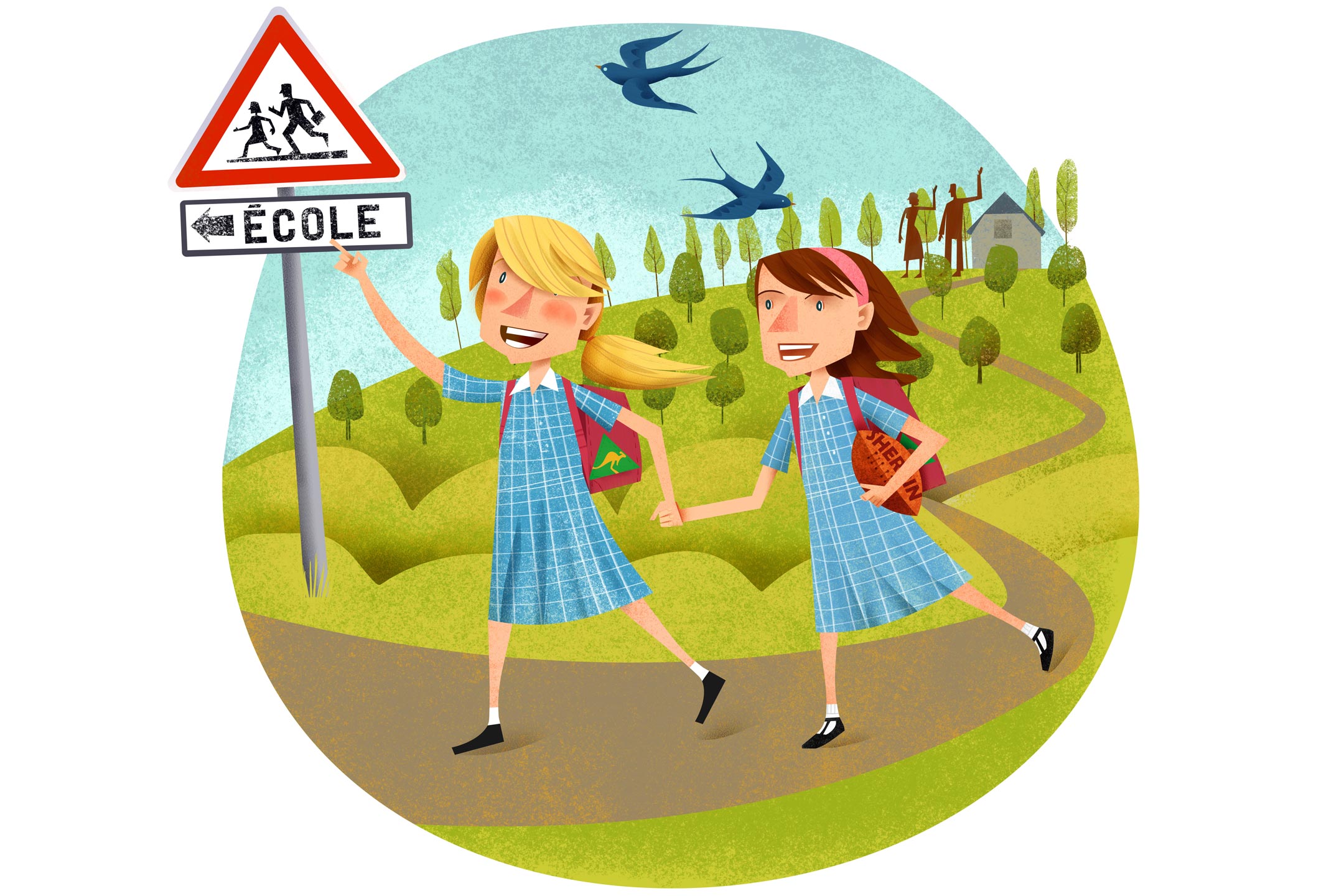
Illustration by Gregory Baldwin