
20 Nov Who’s got a key to your front door? What your family photos reveal online
Sharing photographs of our children online may seem harmless, but small details can reveal more than we realise. Dr Pete Membrey explains why protecting children’s privacy matters more than ever in the age of AI.
Most of us would think twice before handing a stranger a key to our house. We probably wouldn’t give them our address either.
Yet online, we routinely publish enough information for people we have never met to build a surprisingly detailed picture of our families.
Think about the people you follow on Instagram. For some of their children, you probably know their names, what sports they play, where they went on holiday, what they got for their birthday and, in some cases, which school they attend.
None of those things feels particularly sensitive in isolation. The problem is what happens when you put them all together.
Children are becoming more aware of their privacy
Interestingly, children themselves seem increasingly conscious of this.
UK research into children and online safety found that 56 per cent of children aged 11–17 worry about their own online privacy.
The challenge for parents is that the situation becomes more complicated as children get older. The same research found that 60 per cent of parents of 11 and 12-year-olds have activated content filters, but by the time children reach 16 or 17, that falls to just 20 per cent.
Some of that is reasonable. A 16-year-old should have more independence than an 11-year-old. But schools, sports clubs, friends and family can all contribute to a digital footprint that children themselves have surprisingly little control over.
And unlike a conversation at the dinner table, that information does not simply disappear.
AI has changed what can happen to an innocent photograph
Today, generative AI can take an entirely innocent image and create something that never happened. A family photograph, school picture or holiday snap can become the raw material for realistic synthetic content.
Unfortunately, we are already seeing this happen.
The UK’s Internet Watch Foundation identified more than 3,400 AI-generated videos depicting child sexual abuse in 2025, compared with just 13 the previous year.
In one disturbing case, criminals took ordinary photographs from a school’s website and used AI to generate more than a hundred sexualised images of pupils. They then attempted to blackmail the school by threatening to release them.
Nobody had done anything obviously reckless. These were ordinary school photographs, published in an entirely ordinary way.
Technology changed what could be done with them.
Australia’s eSafety Commissioner also warns that children’s photographs shared online can be copied, redistributed or manipulated using AI.
That does not mean parents should panic and remove every photograph of their children from the internet. But we do need to update our idea of what “private” means.
How private are your family photographs?
A private Instagram account with hundreds of followers is not really private in the traditional sense.
Every additional person who can see something is another person who can screenshot it, download it or forward it. Once an image has escaped the boundary you intended for it, getting it back can be extremely difficult.
Check who can see your social media accounts rather than assuming the privacy settings you chose years ago still make sense. Be careful about publishing school names, uniforms, regular locations and routines. Think before attaching a child’s full name to a photograph, and check location-sharing settings.
Privacy rarely comes down to one catastrophic mistake. More often, small pieces of information become revealing when combined.
Talk to your children about what gets shared
The most important privacy tool families have is probably not software at all. It is an ongoing conversation.
Parents should talk to their children about what they are comfortable having shared. As children grow older, they should be increasingly involved in decisions about photographs, accounts and who gets access.
Ask simple questions. Are you happy for me to post this photograph? Does the school really need to publish your full name? Who can see your location? What should we do if someone contacts you in a way that makes you uncomfortable?
Revisit those conversations as children grow and technology changes.
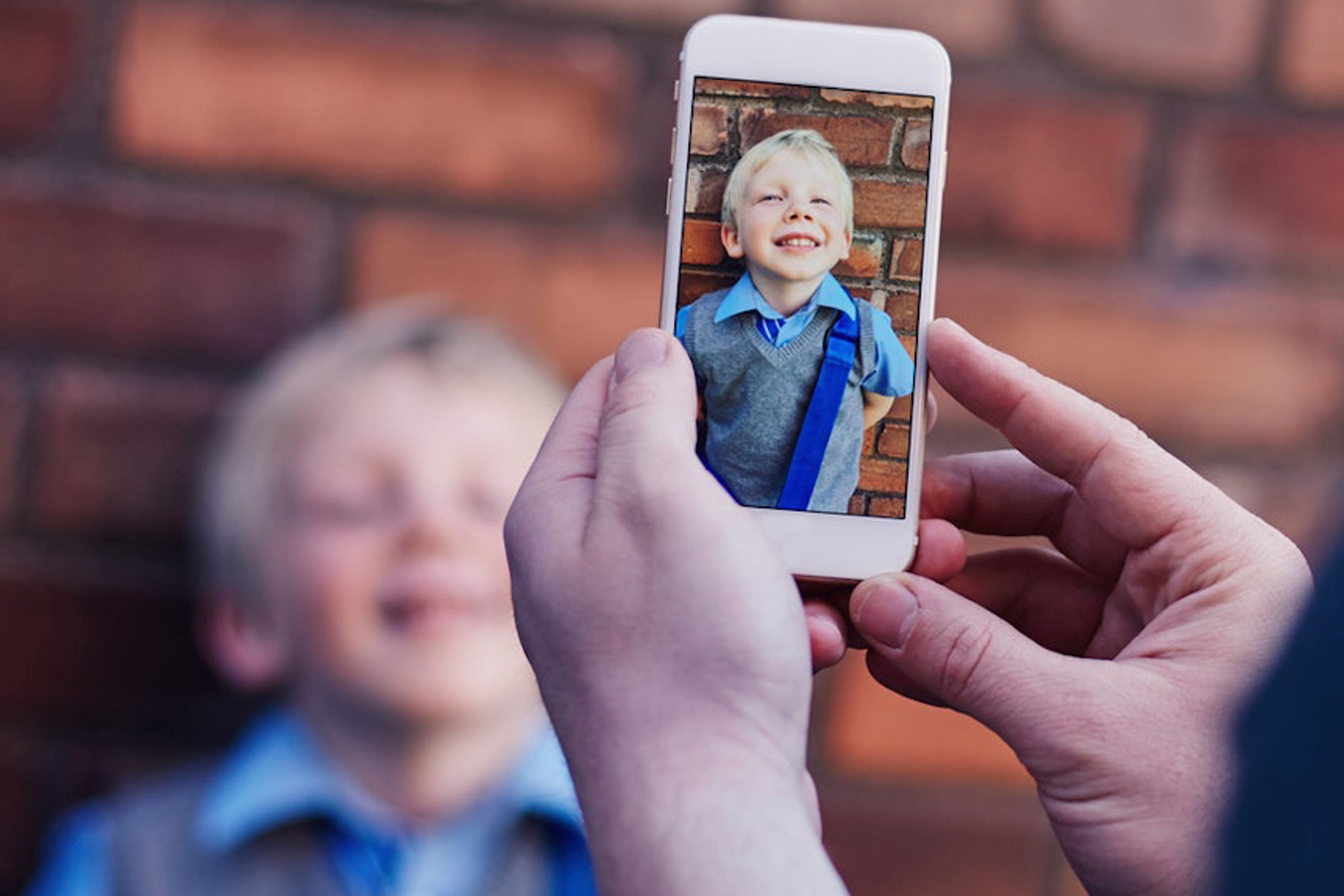
The traditional first-day-of-school photograph does not need to disappear.
But before posting it, look at what else is visible. The school badge on the jumper. The street sign in the background. The house number beside the front door. The child’s full name in the caption. The location attached to the post.
Individually, each piece looks harmless. Put enough of them together, though, and you may have given someone far more than a photograph.
You may have given them the address as well.
Main Image: Sally Anscombe, Getty Images
More information for parents
Australia’s eSafety Commissioner offers practical advice on protecting children’s personal information and photographs online.
Read Privacy and your child – eSafety Commissioner.
About the author
Dr Pete Membrey is Chief Research Officer at ExpressVPN. He writes about online privacy, cybersecurity and digital safety.