24 Nov What does it mean to value childhood for its own sake?
Samantha Brennan looks at sport, art, reading and play…What is good for the child now?
I once gave a keynote address at a philosophy and sport conference (not as an expert on sport, but rather as a children’s rights theorist) and so I did a fair bit of reading on children and sport in the lead-up to the conference.
Again, I found that the literature on children and sport has an unfortunate tendency to focus on adults, rather than the children. The object of moral concern is most often the adult the child athlete will become, and this cuts both ways in terms of the treatment of very young children in sports.
Sometimes an appeal to a balanced childhood is justified in terms of maximising choices for adult life. This is a common argument against children’s involvement in one sport in a serious way. More and more children’s sports require early specialisation if the child is to develop into a competitive adult athlete.
Ethicists writing about children and sport tend to lament this very early commitment and the worry is most often phrased in terms of the child’s future choices. Relatively little attention is paid to what would add the most to the child’s life now, or what would be good for the athlete he or she is now, rather than the athlete he or she will become.
At other times, the appeal to the notion of the adult athlete the child could become if their potential were fully developed is used to argue for children’s participation in seriously demanding sports.
But both sets of argument, though they lead to competing conclusions, share the premise that the right standard for evaluation is the wellbeing, or future choices, of the adult that the child will become.
Consider also children’s art, an example given by Gareth Matthews. Matthews writes that “it has been recognised for some time now that as children of four or five or six years of age each of us was much more likely to produce a painting or drawing of genuinely aesthetic value [than] we are now at 40 or 50 or 60.”
But, for most adults, the recognition of this fact goes no further than assuming that it is appropriate to put a child’s drawing up on the refrigerator door, or display it in the schoolroom for parents’ day. In general, adults are much more likely to denigrate the art of Klee or Miro or Dubuffet for being childlike (‘My child could paint that!’) than they are to assign real aesthetic value to a child’s work for being Klee-like, or Miro-like, or Dubuffet-like.
Child art, argues Matthews, is a particularly good counterexample to the claim that the ‘goods’ of childhood will be, on the whole, derivative from the ‘goods’ of adulthood.
Childhood has value in itself
The point of these examples isn’t to say that we should never think about children as future adults. My point is that it can’t be all that matters.
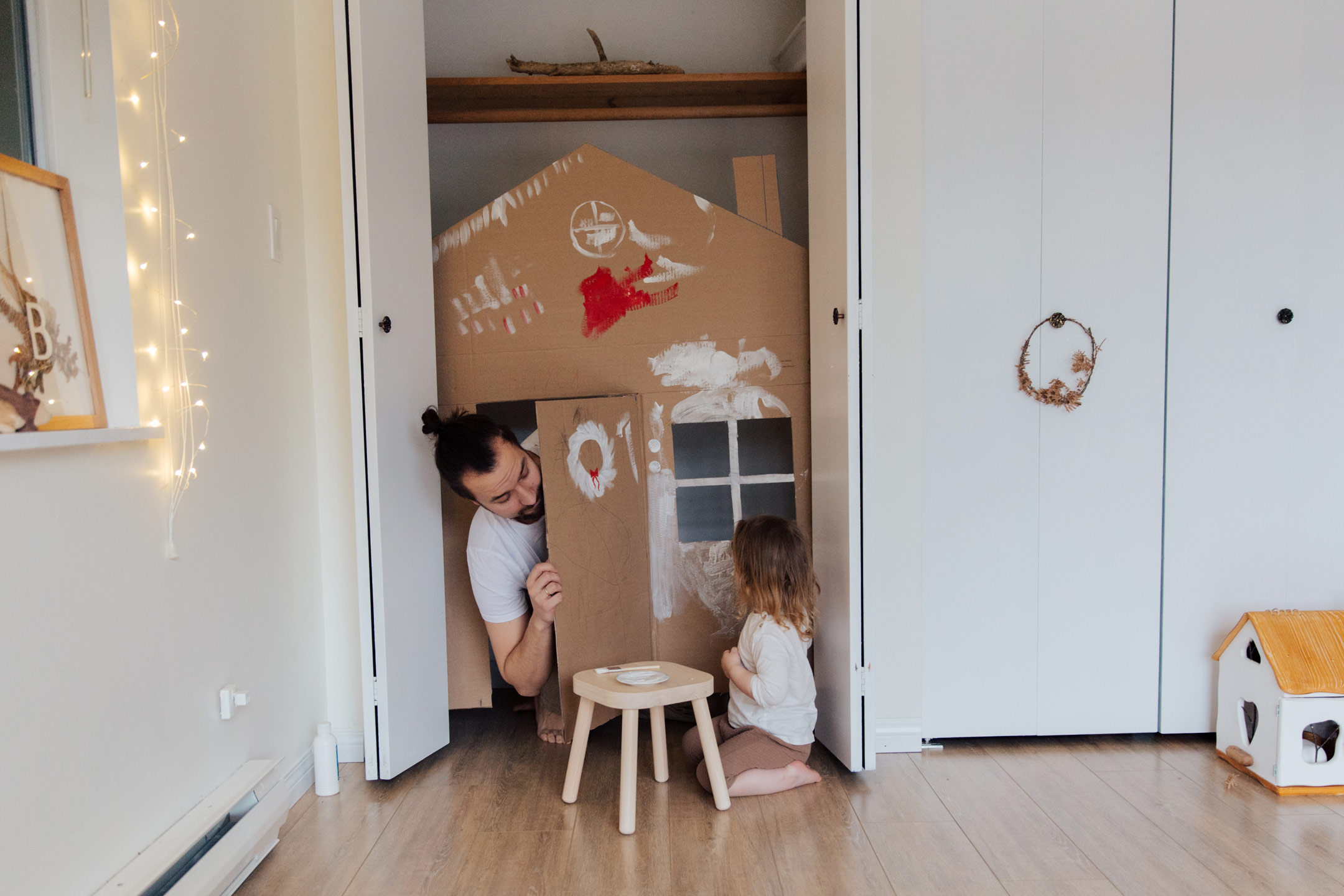
Suppose that reading to children, or playing with them, did not in fact make a difference to their future reading or relationship skills. Still, it might be that we have an obligation to read to and play with our children because it’s good for them now.
Consider the case of the parents of children with developmental disabilities, children who may never learn to read. We may have a duty to read to such children because of the pleasure it gives them now and the connection it forges between parent and child.
One of the things I’ve discovered, as a parent and as a philosopher, is that we need to pay attention to our children.
Children aren’t just persons, property, pets and projects. They are also children, with lives to lead as children, and we should enjoy, appreciate and support them as children.
See Part one: Children: Property, Pets, Projects Or People?
About the author: Samantha Brennan is Dean of the College of Arts and Professor of Philosophy at the University of Guelph in Canada. Her areas of specialisation include moral theory, social and political philosophy, feminist theory and feminist ethics.
Editor’s note: This article was originally published by CHILD in 2008. It has been lightly edited and updated for publication online in 2026.